

Eleven companies have launched their initial public offerings (IPOs) in December 2023, making this month the second-best December for public offerings since 1996. Collectively, they are raising Rs 8,182.7 crore this month. In December 2021, 11 companies raised Rs 9,534 crore. However, excluding December 2021, this month marks the best December for IPOs since 1996.

Given that some reputed builders are also present in this segment and the cheap rates, does affordable housing make a good investment option?

The fundraising through rights issues in the first 10 months of 2022 is the lowest since 2016 during a similar period.

'Banking is a business of trust.'

Private equity (PE) is set to play a bigger role in banks. Of 21 recommendations accepted by the Reserve Bank of India (RBI) out of 31 made by its Internal Working Group (IWG), its stance on non-promoter holdings in private banks is seen with excitement, though it doesn't refer to PEs explicitly. On non-promoter holdings in these banks, the RBI said this will be capped at 10 per cent of the paid-up voting equity share capital in the case "of natural persons and non-financial institutions and entities"; and "at 15 per cent for all categories of financial institutions, entities, supranational institutions, public sector undertaking, or the government." While this is a modification of the IWG's stance for the non-promoter holding in banks at up to 15 per cent, it does open up a huge window for PEs, all the same. This is because, while the RBI has remained silent on the eligibility of industrial houses for bank licences, fresh high-quality capital in large amounts can only come from PEs.


RailTel Corporation of India, Indigo Paints, Home First Finance Company, Indian Railway Finance Corporation, and Suryoday Small Finance Bank are among the companies looking to tap the market.

After a sharp outperformance in the mid-and small-cap segments in the first half of calendar year 2023 (H1-CY23), analysts are now turning cautious on these two market segments and suggest investors stay selective and look for valuation comfort and earnings visibility before investing. The S&P BSE Midcap index has surged 13.7 per cent in H1-CY23, and the S&P BSE Small-cap index gained 12.7 per cent during this period, data shows. The S&P BSE Sensex, in comparison, has moved up 6.4 per cent.

The initial public offering (IPO) market has seen some momentum of late with robust responses to recent issues. However, only some have been able to ride the wave. So far in 2023, 23 companies have let their approval granted by the markets regulator - the Securities and Exchange Board of India (Sebi) - lapse.

'There is a lot of interest from potential clients who have remained away from the markets in past years.' 'They are evaluating whether this is a good time to enter, especially since there are very few alternatives to earn meaningful returns.'

A total of 49 companies raised Rs 81,615 crore in Samvat 2077, more than the preceding four years and almost double the amount raised in the previous year. Samvat 2078 appears even more promising with mega issues of Paytm and Life Insurance Corporation (LIC) of India. However, Paytm's record could be short-lived as state-owned LIC is planning to launch a Rs 1-trillion IPO by March 2022.

Reserve requirements, mandatory investment in G-secs under Companies Act may slow lending for HNI investment in IPOs.

Many people struggle to claim or liquidate investments and insurance policies due to procedural issues.

'RBI was focusing on public sector banks perhaps thinking that private sector banks are managed efficiently while PSU banks are not.' 'Now, RBI has to focus on private sector banks too.'

Inching closer to resolving the Punjab and Maharashtra Cooperative (PMC) Bank issue, the Reserve Bank on Monday came out with a draft scheme for takeover of the crisis-hit bank by the Delhi-based Unity Small Finance Bank (USFB). The draft scheme of amalgamation envisages takeover of the assets and liabilities of PMC Bank, including deposits, by USFB, thus giving a greater degree of protection for the depositors, the RBI said. In September 2019, the RBI had superseded the board of PMC Bank and placed it under regulatory restrictions, including cap on withdrawals by its customers, after detection of certain financial irregularities, hiding and misreporting of loans given to real estate developer HDIL.
IPO market hopes to come out of slump in festive season, reports Sundar Sethuraman.

Retail investors-those investing up to Rs 200,000-lapped up all the four initial public offerings (IPOs) that opened for subscription on Wednesday. This is the first time since 2007 that four IPOs have been launched on a single day, according to information provided by Prime Database. KFC and Pizza Hut franchisee Devyani International (size Rs 1,838 crore); Diagnostic chains Krsnaa Diagnostics (Rs 1,213 crore), pharmaceutical firm Windlas Biotech (Rs 401 crore) and vitrified tiles manufacturer Exxaro Tiles (Rs 161 crore) are the four companies whose IPOs opened on Wednesday.

While a coordinated aggressive monetary easing from the central banks is most likely to offer some respite in the near-term, it is unlikely to improve the sentiments.

'NRI interest has gone up in the past three-four years.'
The initial public offering (IPO) market has come to a grinding halt due to sharp correction in the broader markets and uncertain outlook created by the Russia-Ukraine offensive. So far this year, only three companies have managed to launch their maiden share sales. In comparison, close to 10 companies were able to come out with their IPOs during the same period last year. Investment bankers say it will be challenging to launch a single deal in March as large institutional investors have turned extremely risk-averse and don't wish to commit any capital.

While office and mall properties enjoyed revival and saw some big PE deals, residential real estate was hit by double whammy - stagnating prices and demonetisation

'Investors should reduce cash gradually and look for value investing.'

'What made him different was that he was not a banker at all by temperament.' 'He was a businessman, a typical lalaji at that.' 'He had to win at any cost.'

'Some business families would probably have to revert to their core businesses, which the IBC will ensure.'

Investors became richer by over Rs 6.34 lakh crore on Monday as markets gave a big shout-out to the Budget 2021-22, which analysts termed as 'unprecedented' against the backdrop of the pandemic-induced slowdown. Cheering the Budget proposals, the BSE benchmark Sensex zoomed 2,314.84 points or 5 per cent to close at 48,600.61. During the day, it jumped 2,478.63 points to 48,764.40. This was the best Budget-day gain for the markets since 1997, analysts said. Following the extremely positive market sentiment, the market capitalisation of BSE-listed companies rallied Rs 6,34,069.67 crore to Rs 1,92,46,713.70 crore.

Draft prospectus to be filed next week; second trust, with Panchshil, in a few months

Ajit Mishra, vice president, Research, Religare Broking, answers your queries.
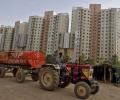
Aggressive acquisitions & deep pockets fuel real estate competition; experts suggest future partnership

'In the business of money, where you are regulated, the liability lies on the head of the acquirer.' 'It is not a good thing when you cannot spot the risks.'

Looking for a way out, property developers deal in banned notes.

The world's biggest lockdown that shut a majority of the factories and businesses, suspended flights, stopped trains and restricted movement of vehicles and people, may have cost the Indian economy Rs 7-8 lakh crore during the 21-day period, analysts and industry bodies said.

What stocks will gain from a normal monsoon?

The consolidated entity can target good growth FY18 onwards, analysts say.

As India emerges from the COVID-19 crisis, the ninth budget under the Modi government, including an interim one, is widely expected to focus on boosting spending on job creation and rural development, generous allocations for development schemes, putting more money in the hands of the average taxpayer and easing rules to attract foreign investments.

The reason is believed to be a 19% increase in interest cost.

10 analysts estimated RIL's consolidated net profit at Rs 11,256 crore and nine analysts estimated revenue at Rs 1.5 trillion.

Experts said equity raising was also hampered due to flight of capital from foreign investors. FIIs have sold more $500 million (Rs 3,200 crore) in October.

There was broad-based rally with participation across sectors creating enormous wealth for investors but starting 2018, the rally got concentrated into select large-cap companies with under performance in broader markets.

Banks stocks continued to trade weak along with FMCG major ITC.
